Borders & EnforcementEntry PF-505614 · Page 15 · Stamped OCT 10, 2026
Ceuta: Thousands of Migrants Remain as Authorities Seek Help
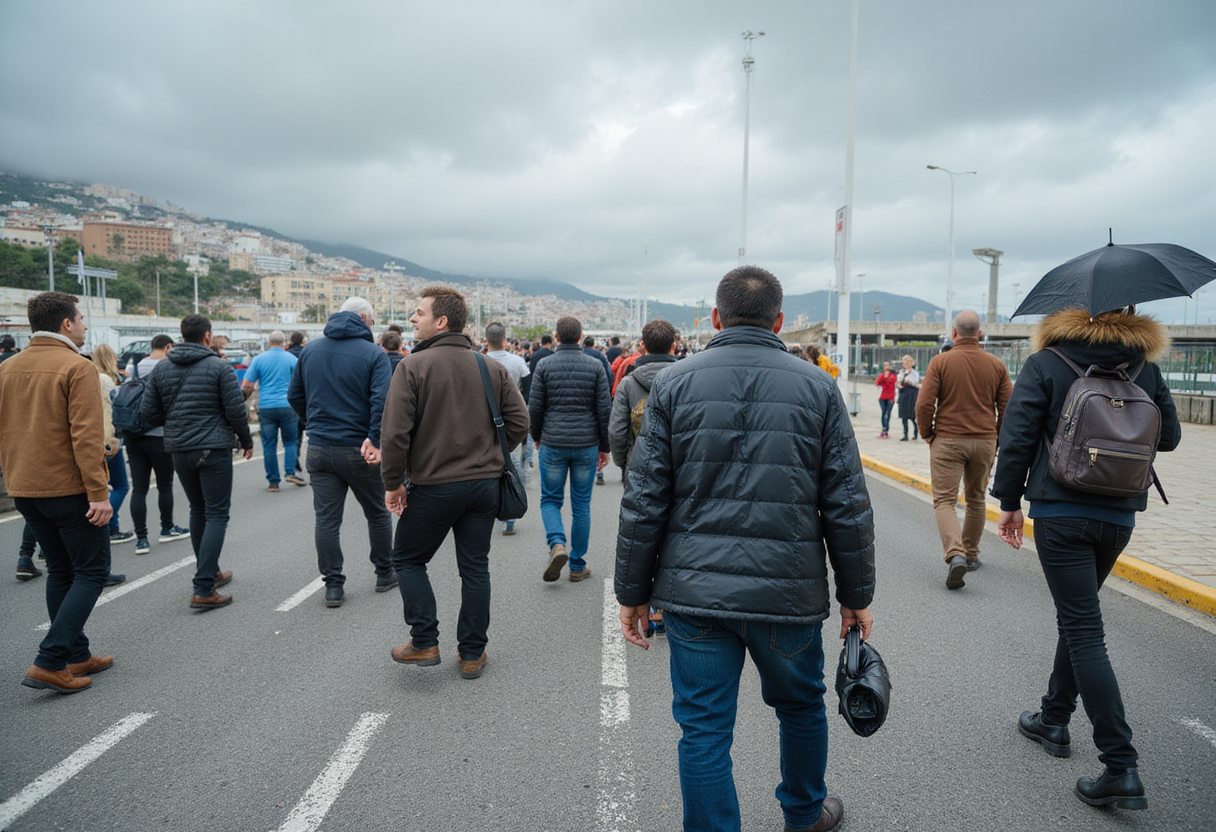
Thousands of migrants remain in Ceuta after irregular crossings from Morocco. Spanish authorities have publicly called for additional help to manage the situation, according to InfoMigrants.
- Programme
- Borders & Enforcement
- Filed
- Reading
- 3 min
Entry details
- Thousands of migrants remain in Ceuta after irregular crossings from Morocco, according to InfoMigrants.
- Spanish authorities have publicly called for additional help to manage the situation.
- Ceuta and Melilla form the EU's only land borders with Africa.
- Adult Moroccan nationals are typically returned under the bilateral readmission agreement between Madrid and Rabat, first signed in 1992.
- Ceuta sits about 400 km west of Melilla along the North African Mediterranean coast.
Thousands of migrants remain in Ceuta after crossing irregularly from Morocco. The figure comes from a report by InfoMigrants titled "Ceuta: Thousands of migrants remain, as authorities call for additional help." Spanish authorities have publicly called for additional help to manage the situation.
The available summary does not specify the exact number of migrants, the date of the latest arrivals, or the names of officials speaking. No direct quotation appears in the source headline.
What is happening in Ceuta?
Ceuta is a Spanish autonomous city on the North African coast. It sits across a land border from Morocco. The neighbouring enclave of Melilla lies about 400 kilometres east along the Mediterranean.
Both cities form the bloc's only land borders with Africa. Both have a long record of irregular migration attempts, often concentrated in short bursts when Moroccan border surveillance is relaxed.
Who is asking for help?
The InfoMigrants headline does not name the authority making the call. The options include:
- The Spanish government's delegate in Ceuta
- The Ceuta city government
- The Spanish Ministry of the Interior in Madrid
- Regional child-protection services
The specific form of "additional help" is also unspecified. Past appeals in similar situations have requested:
- More Guardia Civil officers
- More national police officers
- Larger reception-centre capacity
- Additional case workers for asylum claims
Who is affected?
The migrants affected are people who crossed irregularly from Moroccan territory into Ceuta, generally over or around the border fence. Past arrivals have been mostly Moroccan nationals, with smaller numbers from sub-Saharan African countries.
Adult Moroccan nationals are typically returned to Morocco under the bilateral readmission agreement between Madrid and Rabat. Unaccompanied minors, asylum seekers, and other persons in need of international protection cannot be returned summarily. They enter the Spanish reception system.
How is Spain's readmission framework structured?
Spain and Morocco operate under a bilateral readmission framework first signed in 1992, with successive protocols in 2012 and 2019. The agreement governs the return of Moroccan nationals and, in some cases, third-country nationals who transited Morocco before reaching Spain.
Returns must follow Spanish procedural law, which requires a signed return order, a documented interview with the returnee, consideration of any pending asylum claim, and notification of appeal rights.
Summary returns at the border fence have been the subject of repeated litigation in Spanish and European courts.
Why does this matter beyond Ceuta?
Decisions taken at the Ceuta border are monitored across the EU. The European Commission funds border infrastructure in the enclaves and reviews Spain's compliance with EU asylum law. Spanish and Strasbourg courts have repeatedly examined the legality of summary returns at the fence.
The Western Mediterranean route, of which Ceuta forms a part, is one of three principal irregular-migration corridors into the European Union. The other two are the Central Mediterranean route to Italy and the Eastern Mediterranean route to Cyprus and Greece.
What role do the EU and Frontex play?
The European Border and Coast Guard Agency, Frontex, coordinates joint operations at the EU's external borders. Spain hosts several of these operations on its southern frontier.
The European Commission funds border infrastructure in the enclaves and reviews Spain's compliance with the Common European Asylum System and the Schengen Borders Code. The European Union Agency for Asylum, EUAA, supports Spain with asylum-processing capacity during surges.
What are the limits of this report?
This article draws only on the headline and a brief summary of the InfoMigrants report. It does not include direct quotations from officials, the exact headcount, the date of arrival, or the specific resources requested. The full report is required for those details.
For authoritative figures, consult InfoMigrants' full article, the Spanish Ministry of the Interior's press releases, Frontex's Western Mediterranean operational data, and the European Commission's migration statistics for Spain.
via GN InfoMigrants (Source)